
 As you think about preparing yourselves and/or your families for possible illness due to the current Corona Virus outbreak, it can give you great peace of mind to have plans in place for your pets too!
Below are some tips in order to have your pet ready to go to boarding or temporary foster should you contract the virus.
Dogs: Be sure you dog is up to date on their core vaccines; i.e., canine parvovirus, distemper, canine hepatitis and rabies are considered core vaccines. Be sure to have proof via paperwork from administering veterinarian. Non-core vaccines are given depending on the dog’s exposure risk. Note: Bordatella would be necessary for boarding at most boarding facilities.
**BOARDING FACILITIES MAY ASK FOR PROOF OF VACCINES AND YOU MAY BE TURNED AWAY WITHOUT THAT INFORMATION**
Cats: core vaccines include feline panleukopenia, feline calicivirus, feline rhinotracheitis (also known as feline herpesvirus), and rabies. Be sure to have proof via paperwork from administering veterinarian.
Identification:
• Tags on collars-
• your phone number
• rabies tag
• current dog license, (be sure license information is current)
• microchip tag, (be sure chip company has correct owner contact information)
Pack a bag:
• Preferred toys
• bag of the food your pet eats (a change in food can cause GI upset)
• For cats-kitty litter and pan
• List of meds and directions if applicable
• Proof of vaccines and corresponding paperwork
• Pet insurance information
Important information about your pet:
• Pets name, age, description
• Basic daily schedule
• Likes and dislikes
• General information to make a transition easier(loves the red ball, loves scratches behind ears, do not touch paws, etc)
• Any medications with direction (get an extra refill if you can in case of supply chain interruption)
• Veterinarian and their contact information
Remember to isolate pets if someone is infected with the virus in a multi-human household. Wash your hands after handling your pets in a multi-human household. Fomites know no boundaries!
Behavior and Enrichment:
Remember that while things have changed for you and possibly other family members/children, your pet(s) life has changed too. They are not used to increased activity at times then they were home alone and had the house as their own.
Pets are very sensitive to our feelings, more than we are to each other’s. If you are feeling stressed, under pressure, impatient, or have financial concerns they know something is very wrong. Make a schedule for your pet like you would your children including very important “down time.” We all get impatient and/or angry, it’s okay to walk away from your pet or put them outside in a fenced in yard or on a lead for a bit to reduce your level of frustration.
If you have children at home have them create toys for your pets.
• Sock toys for dogs
⁃ old tube/knee sock with no holes
⁃ Fabric paints/markers
⁃ Tennis balls or other ball of similar size
Let kids get creative in painting the sock, after dry, put ball in toe portion of sock, tie a knot above the ball. Use the loose end as a way to throw the sock! If it gets muddy, dirty, throw it in the wash!
• Catnip Sock toy for cats
⁃ Find an old unwanted sock. Check that it is free of holes, or the catnip will fall out
⁃ Fabric paint/markers to paint the sock toy
⁃ Slide a toilet paper roll inside the sock (we should have plenty of those!!)
⁃ Stuff some dried catnip into the sock
⁃ Tie the loose end of the sock in a knot
⁃ Done!
• Snuffle Mat- https://youtu.be/RMYVNWmvJHY
• Snuffle mat directions: https://youtu.be/3s0cDtTlaxc
• Serve your dogs meals in muffin tins or a treat dispensing toy like a Kong wobbler.
• Play “find it” by hiding treats around the room or under boxes.
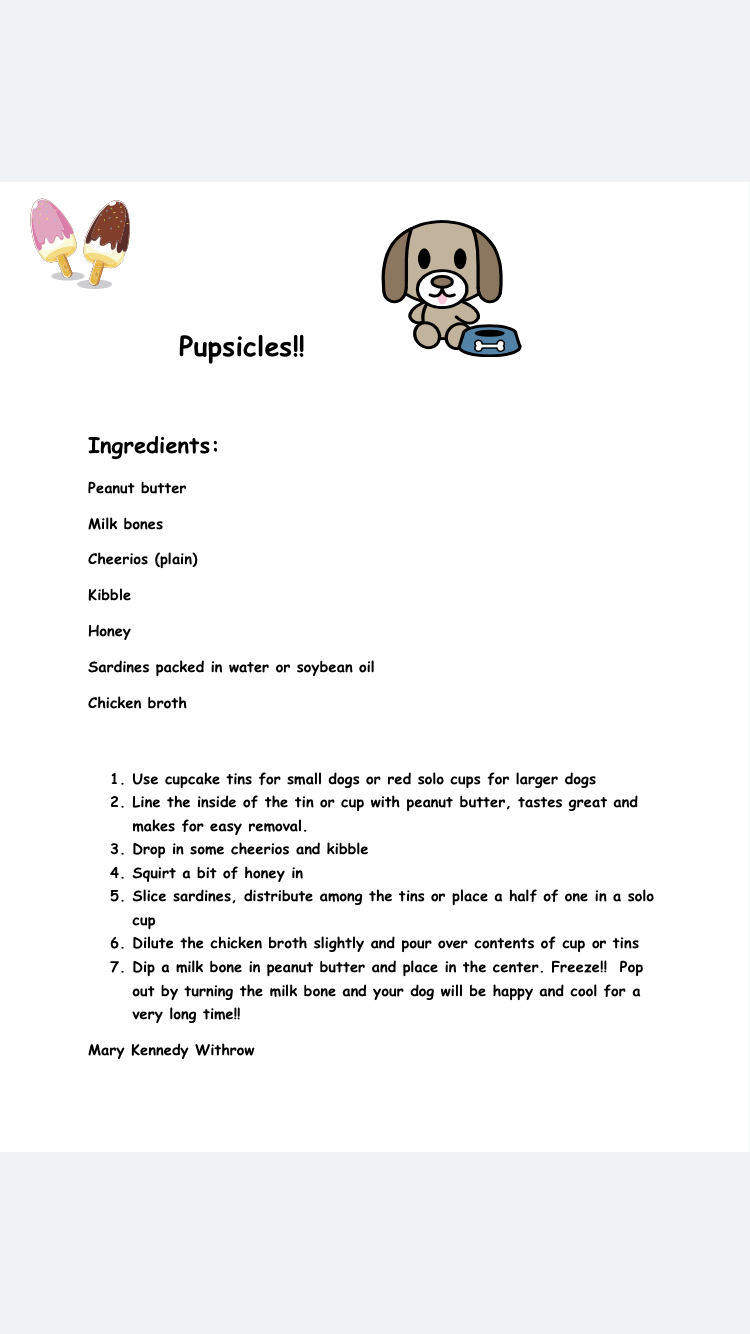
• Have your kids make “pupsicles” for your pets. (Recipe below)
• Cats like to bat around lids from pop/water bottles or the ring from below a milk container lid.
• Cats like laser lights – HOWEVER—DO NOT USE A LASER LIGHT WITH A DOG – very important. (Google laser light syndrome in dogs 🙌🏻 )
Frozen Kongs, toilet paper/paper town rolls filled with treats and the ends folded down can be a very easy to make toy for a cat or dog!
Licky mats with Peanut butter or Greek yogurt is also fun!
Get creative!!
Other suggestions:
• Remember when dogs are eating or sleeping leave them be and teach your kids to do the same.
• Don’t let children treat the pet like a toy. Some dogs may *tolerate* children lying on them, playing with their ears, tail, paws, but trust me, no dog or cat likes that. Teach your kids to watch for stress signs in dogs. Here are a few more recognizable:
• Lip licking
• ears pinned
• yawning
• whale eye (see whites of eyes, think stink eye)
• tail tucked
• panting
Remember you are invading their space during these times, cut them a break and respect their life changes too!
• If your dog growls, stop what you are doing as it is making them uncomfortable but do not reprimand a dog for growling. Address the reason for the growl but they must have their growl. It’s a warning, if they can’t growl they are left with one thing—a bite. Taking a growl away from a dog is like removing the batteries from a smoke detector.
• Be sure they have a safe place. (Room, crate, (crate not to be used for punishment) where they can get away from the increased activity/people.
• Prepare a way to secure your pet(s) should a first responder need to enter your home. (Designated room, baby gates, basement)
• Put a pet sticker on your window indicating what pets and/or species are inside and how many. If you don’t have a sticker make a list and tape it on your front and back doors. Include your phone number. (Unless there is a security reason that would make that unsafe)
WISE WORDS FROM A WISE FRIEND:
COVID-19 & Your Pet’s Emotions
Beyond the basic needs for your pets such as food, shelter and medical, please remember your pet’s emotional needs too.
Dogs and cats are very attuned to our emotions.
- During these stressful times, we know why we are stressed but our pets do not.
- They can sense our emotional trauma and don’t understand why.
- Our pets can interpret our emotional distress as being an aggressive action towards them, thus resulting in wanting to protect themselves, i.e. biting, scratching, etc…
- They can also redirect their anxieties to other people and pets if they feel other people or pets are responsible for our stress.
Pets need their own time and space.
- Before Covid-19, when you went to work, your home became your pet’s domain. Now, if you are staying home, you may be invading their time and space causing them stress. As much as your pet loves you, they still may need their own time without you.
- This also applies to your children. Don’t expect your pet to be the children’s entertainment all day long. Your pets may need a break from them too.
- Try to find a quiet place in your home where your pet can decompress and reward them with enrichment options such as treat, toys, etc.
Forgive your pets!
- When things change in the home pets can react in ways we do not find appropriate such as defecating & urinating, destructive behaviors such as chewing & scratching.
- As upsetting as this may be. Do not overly correct them. These behaviors are often how they deal with stress. And these are stressful times for both humans and animals.
During this crisis, we will feel frustrated, angry, scared. So just as you do with your children, try not to let your pets see you experience these emotions. If that is not possible, which is perfectly understandable, then reassure your pet and comfort them just as you would do your child.
Pets can be one of the most important emotional tools to see up through this crisis. Our pets give us so much comfort, joy, security and love, so please remember as much as we need that from them, they need the same from us. “
 2hotsandakong